The mattress is the heart of the room: it’s what guests judge when they wake up, and sleep is the topic that comes up most often in reviews. Choosing a hotel mattress means finding the comfort that will suit the most people, with the durability to last thousands of nights.
Comfort: aim for the majority
A hotel welcomes every body type and every sleeping habit. The rule: a medium feel, neither too firm nor too soft.
| Comfort | Who for | Hotel use |
|---|---|---|
| Firm | Back sleepers, heavier builds | Business hotels, preferred by some guests |
| Medium | Most sleepers | Recommended standard |
| Soft / cocooning | Side sleepers | Higher categories, with a topper |
A mattress topper is the ideal way to adjust comfort without changing the mattress: a softer feel for a suite, or an option for a guest who asks. See our mattress toppers.
The technologies
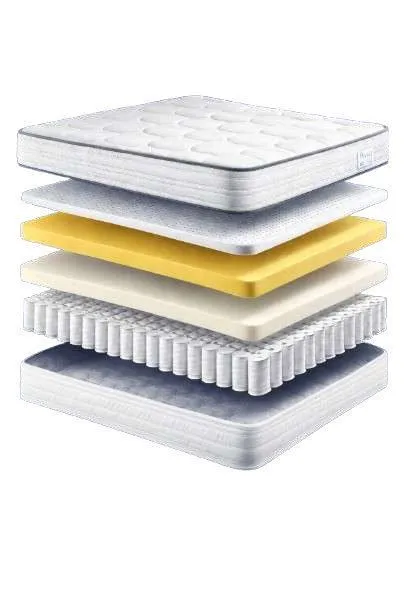
- Pocket springs: each spring works independently. Excellent motion isolation (you don’t feel your partner move) and very good ventilation. Models with comfort zones (5 or 7 zones) support the shoulders and hips differently.
- High-resilience foam: light and durable, it recovers its shape quickly. Ideal for extra beds, bunk beds and controlled budgets.
- Memory foam: it moulds to the body for a cocooning feel, often as a comfort layer above the springs.
- Natural fibres: wool and cotton, for better temperature regulation.
Our range of hotel mattresses covers all of these technologies, from high-resilience foam to 7-zone pocket springs, with memory foam or natural fibres.
Single- or double-sided?
- A double-sided mattress can be turned over: wear is spread out and it lasts longer.
- A summer/winter mattress has a cool side and a warmer side.
- A single-sided mattress with a zip-on topper makes upkeep easier: you replace the topper, not the mattress.
Whatever you choose, set up regular rotation (head to foot, and turning over if the model allows): it’s the first step in extending a mattress’s life.
Sizes
| Size (cm) | Use |
|---|---|
| 90 × 200 | Twin beds, pushed together or apart |
| 140 × 190 | Standard double, small rooms |
| 160 × 200 | Queen size, the standard in mid-range and upscale hotels |
| 180 × 200 | King size, superior rooms and suites |
Two 90 × 200 mattresses on two bases give a 180 × 200 bed that converts into twin beds: valuable flexibility for adapting rooms to demand. In France, the official hotel rating scheme sets minimum bed sizes by category: check it for your project.
Hygiene and upkeep
- Treated fabric (anti-dust-mite, antibacterial depending on the model) and a mattress protector on every bed.
- Handles for rotating the mattress and changing the sheets.
- A depth suited to the bed linen you use: a mattress that’s too deep for your fitted sheets won’t be properly covered.
Matching the bed base
The mattress and base work together: an excellent mattress on a worn-out base loses its comfort. Choose the total bed height to suit your furniture (headboard, bedside tables). See our guide to hotel bed bases.
How long does a hotel mattress last?
It all depends on occupancy, quality and upkeep. The tell-tale signs: dips, sagging, springs you can feel and guest complaints. We explain how to plan replacement in our article on how long hotel bedding lasts.
In short
- A medium feel for most guests, fine-tuned with a topper.
- Pocket springs for motion isolation, HR foam for extra beds.
- Sizes suited to your rooms, with twins that can be pushed together.
- Regular rotation and a mattress protector.
Bedding lead time: about 4 weeks. Send us your bed breakdown by room for a quote within one working day.